Christine’s Story: “A little voice, a dorinkie, and a whole lot of courage”
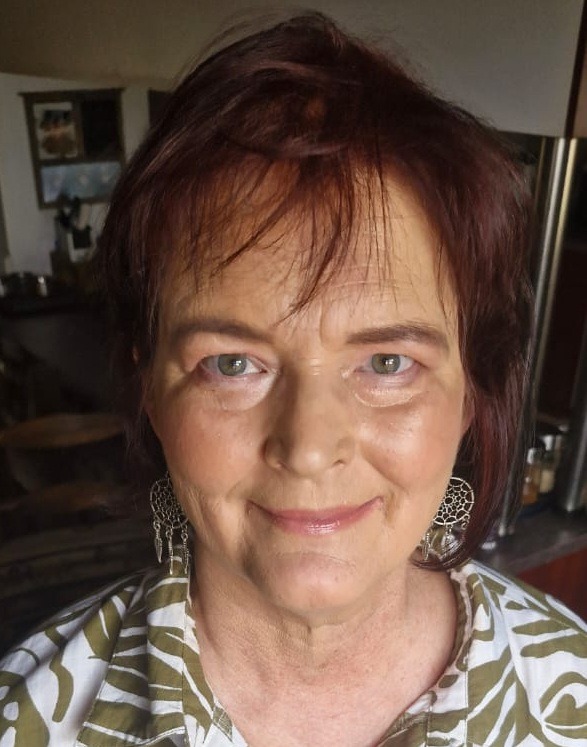
When Christine Marais felt a tiny “dorinkie” (a thorn-like sensation in her breast), she never imagined it would mark the beginning of a life-changing journey. At almost 64, with no symptoms and only a faint bluish mark to hint that something was wrong, she trusted her instincts and acted quickly. That decision, she says, made all the difference.
A discovery that changed everything
“It felt like a small thorn,” Christine recalls. “But when I touched it, it was hard like a tabletop.” She showed her husband, and the look on his face told her everything she needed to know. “His eyes went to saucer size. I just knew there was trouble in paradise. With a capital T.”
There is breast cancer on her mother’s side of the family, but nothing on her father’s. Even so, the diagnosis came as a complete shock. “No symptoms except the dorinkie. One out of the blue, struck‑by‑lightning experience.”
Listening to the little voice
Christine immediately made an appointment with her general family doctor. He wrote a reference letter for a mammogram, and she made an appointment with Pathcare for 08h00 the following day
Within days, she had a mammogram, a breast sonar, and a biopsy.
Her cancer was diagnosed at Stage 1C. Early, small, and treatable. “All the doctors asked why I responded so quickly. Honestly, a little voice in my head urged me. I just knew everything was not okay.”
Treatment, decisions, and the reality of recovery
Further tests determined that Christine would not benefit from chemotherapy. The oncologist made an appointment with Prof Justus Apffelstaedt in Windhoek for 10 November 2025.
“I went for an oncoplastic tumor excision at Louis Leipoldt Medical Clinic,” says Christine. “The cancer was excised, and six sentinel lymph nodes were removed. The removal of the cancer was integrated into a normal breast reduction; the other breast also reduced to look-alike.”
Recovery has been slower than she expected.
“There’s a big hiccup people don’t talk about,” she explains. “There are a lot of surgical options which have a cosmetic aspect to them, and some medical aids see it as purely ‘cosmetic.’ Each one has its own recovery time.”
Twelve weeks after surgery, she is on letrozole which will reduce her chance of the tumour coming back by half. More advanced tumours or tumours of a different type may require chemotherapy, biologicals or immunotherapy or combinations of these with hormonal therapy.
The emotional journey: sunshine, storms, and everything in between
Christine speaks openly about the emotional impact of breast cancer.
“You alternate between Sally Sunshine and Betty Donderwolk,” she says. “Your physical health is important, but you must take care of your mental health too.”
She describes moments of depression and grief for her “before cancer days,” but also a deep sense of resilience.
“It’s okay to have days where you cry your eyes out. Don’t be so brave that people think you don’t need comfort.”
Side effects, support, and what helps
Letrozole has caused foot pain, though she jokes that her inherited flat feet aren’t helping. What has helped her most is emotional support and faith.
“You need someone you can trust with your deepest emotions and insecurities. And trust God.”
A new season, a new strength
Christine describes this chapter of her life as a “new season with its own challenges.” She is honest about the hard days, but her humour, intuition, and courage shine through every part of her story.
“You’re not a crab moving backwards,” she says. “You shoulder forward.”
And she has. With strength, honesty, and heart.
Christine’s advice to others
Christine’s message is simple and powerful: “Know your own body. If anything looks out of place, get help as soon as possible. Don’t wait and hope it will mysteriously vanish. Early detection is your best way forward.” She also offers a gentle reminder about the people around you: “Your partner, family, and friends will feel overwhelmed. Some will say the most inconceivable things. Some will avoid you. And then there are the prophets of doom who tell you horror stories. Find a way to zone them out.”
Once a cancer diagnosis is made, what is the next step?
The surgeon will work with you, as part of a multi-disciplinary team, to discuss your surgical treatment options.
Should the surgeon specialise in breast cancer?
Yes, they should. Surgery has been a mainstay of breast cancer treatment for several decades. It is often the sole treatment required in the management of early-stage breast cancer. Understanding the current recommendations for surgical treatment is vital in the accurate diagnosis, staging, and treatment of patients with breast cancer. Whilst the surgery itself might be low risk, a multitude of complications can occur for both lumpectomy and/or mastectomy, so a surgeon that has a special interest in breast cancer surgery is strongly recommended. Your specialist surgeon should ideally regularly undertake more than 150 surgeries per year.
What types of surgeries will a breast cancer surgeon discuss with me?
The surgeon will discuss with you the best possible surgery for your type of breast cancer. This must be done in consultation with your oncologist. Breast-conserving surgery will be a primary aim, where possible and surgeries can include surgery to remove a portion of the breast tissue, called lumpectomy. In about half of the cases, removal of the tumour in the breast will be incorporated into a breast lift or reduction to prevent asymmetry and facilitate radiotherapy; hence the involvement of an oncologist and a plastic surgeon in the multidisciplinary team is paramount.
Who else will be in the surgical team?
In the surgical team there needs to be a surgeon with a special interest in oncologic breast surgery who understands the details of breast imaging , a plastic surgeon who can offer the entire bandwidth of oncoplastic and reconstructive techniques, an anaesthetist who understands the specific requirements of cancer surgery anaesthesia and a nursing sister who can support the surgical team in these, at times, very long and complex procedures.