
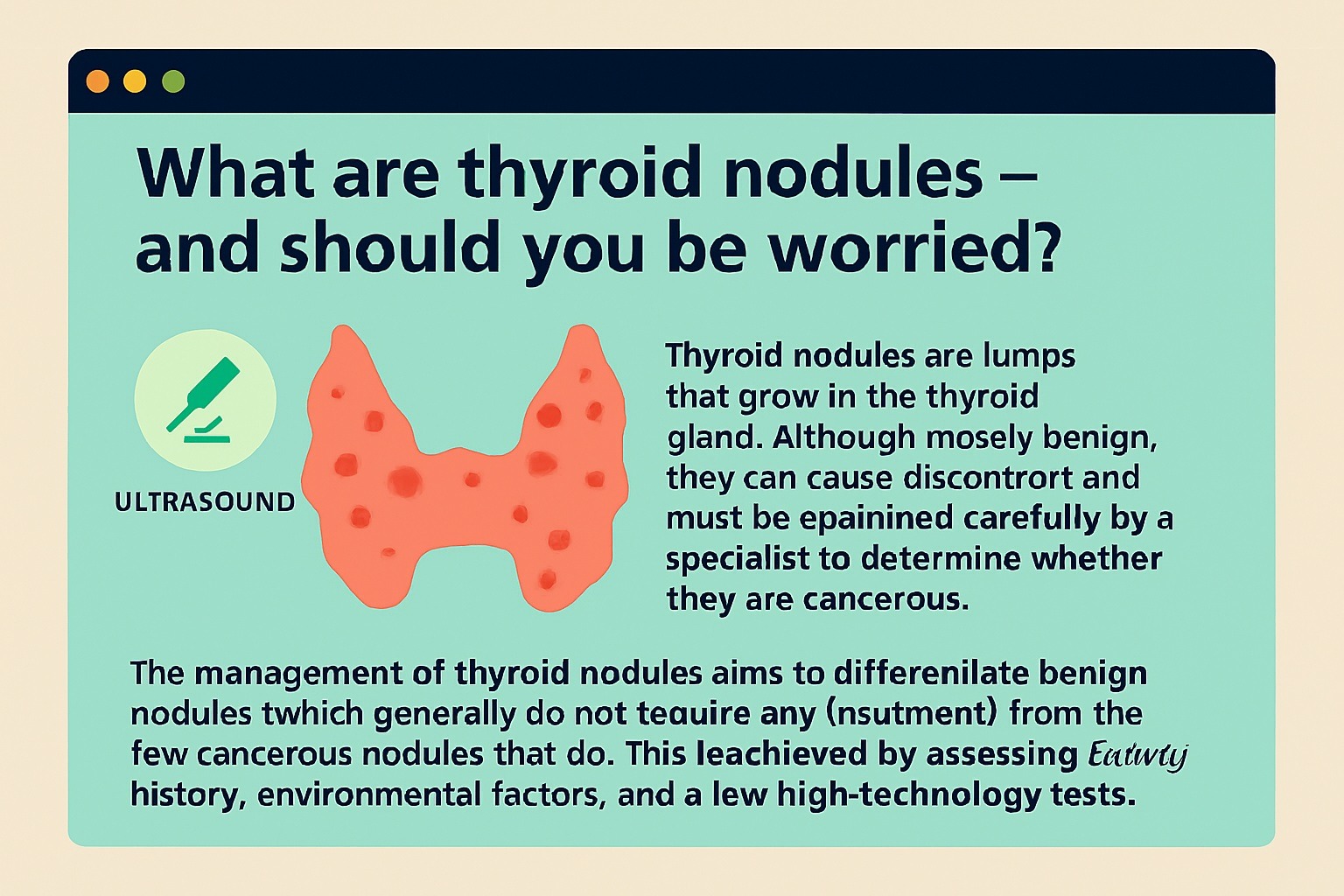
Thyroid nodules: What are they – and should you be worried?
Thyroid nodules are lumps that develop in the thyroid gland and can cause swelling and discomfort. Although fairly common and rarely cancerous, they must be managed carefully by specialists.
Here’s what you need to know.
Thyroid cancer is being diagnosed with increasing frequency in recent years, so responsible management of the thyroid is an important part of remaining healthy. But it’s not only cancer that patients should know about.
What are thyroid nodules – and should you be worried?
Thyroid nodules are lumps that grow in the thyroid gland. Although mostly benign, they can cause discomfort and must be examined carefully by a specialist to determine whether they are cancerous.
The management of thyroid nodules aims to differentiate benign nodules (which generally do not require any treatment) from the few cancerous nodules that do. This is achieved by assessing the family history, environmental factors, and a few high-technology tests.
Screening and diagnosis
Thyroid nodules may be discovered either by the patient during self-examination, by a specialist during a physical examination, or more and more commonly in recent times, incidentally at vascular or orthopedic investigations for unrelated problems. These investigations are usually ultrasonography (US) imaging – the use of high-frequency sound waves to produce images, computed tomography (CT) –an X-ray scan used to obtain detailed internal images of the body, or magnetic resonance imaging (MRI) – a type of diagnostic test that creates detailed images of nearly every structure and organ inside the body.
Thyroid nodules can have many causes, either benign or malignant (cancerous). Specialists will therefore start investigating the nodule’s form and origin.
You will typically have a first assessment that includes a detailed history and physical examination. Your doctor may ask questions about your environment and history, including whether you have been exposed to irradiation, whether you have a family history of thyroid cancer or vocal cord paralysis, or other details that can give an indication of your risk for a malignant nodule.
Depending on what the first assessment reveals, specialists will perform further tests to better understand what they are dealing with. Today, a broad range of tests are available that allow for precise diagnosis.
The two most important tests are a thyroid-specific ultrasound, which can determine whether a nodule looks suspicious enough to warrant the second test and a Fine Needle Aspiration, a procedure used to obtain a cell sample from a suspicious lump or abnormal area. The aspiration should be done under ultrasonographic guidance. This will allow for a definitive diagnosis in most cases. Blood tests for thyroid functions and a scintigraphy, where an isotope is injected to generate a functional-anatomical correlation, are less important. Rarel,y surgery, in the form of a removal of the lobe of the thyroid where the nodule is, is required to make the final diagnosis.
Treatment
Treatment will be guided by the diagnosis. Most nodules are colloid nodules (benign buildups of thyroid cells and the storage medium for thyroid hormones which is colloid) and do not require any specific therapy. These are only removed if the patient experiences symptoms such as pain and swallowing discomfort. In cases where cancer is diagnosed, the management should be decided upon by a multidisciplinary clinic comprised of surgeons with a special interest in thyroid surgery, together with medical and radiation oncologists.
More recent treatment methods also include Radiofrequency ablation (RFA). This sees the use of heat to either shrink or destroy benign thyroid nodules. As per Mayo Clinic, “Radiofrequency ablation, which many people might simply call an RFA, is a way of targeting a specific part of the thyroid, an abnormal part, by delivering high energy into that specific area of the thyroid and destroying it.” [1] The benefits include retaining thyroid function, reduction of scarring on the neck and the ability to perform it in an outpatient setting.
Most thyroid cancers are slow-growing cancers that, if managed appropriately, have an excellent prognosis. Only rarely are aggressive cancers found that require more intensive treatment. A rare and special form of thyroid cancer, medullary carcinoma (a tumour arising from parafollicular or C cells), is part of an inherited genetic syndrome and should only be treated in specialised centres.